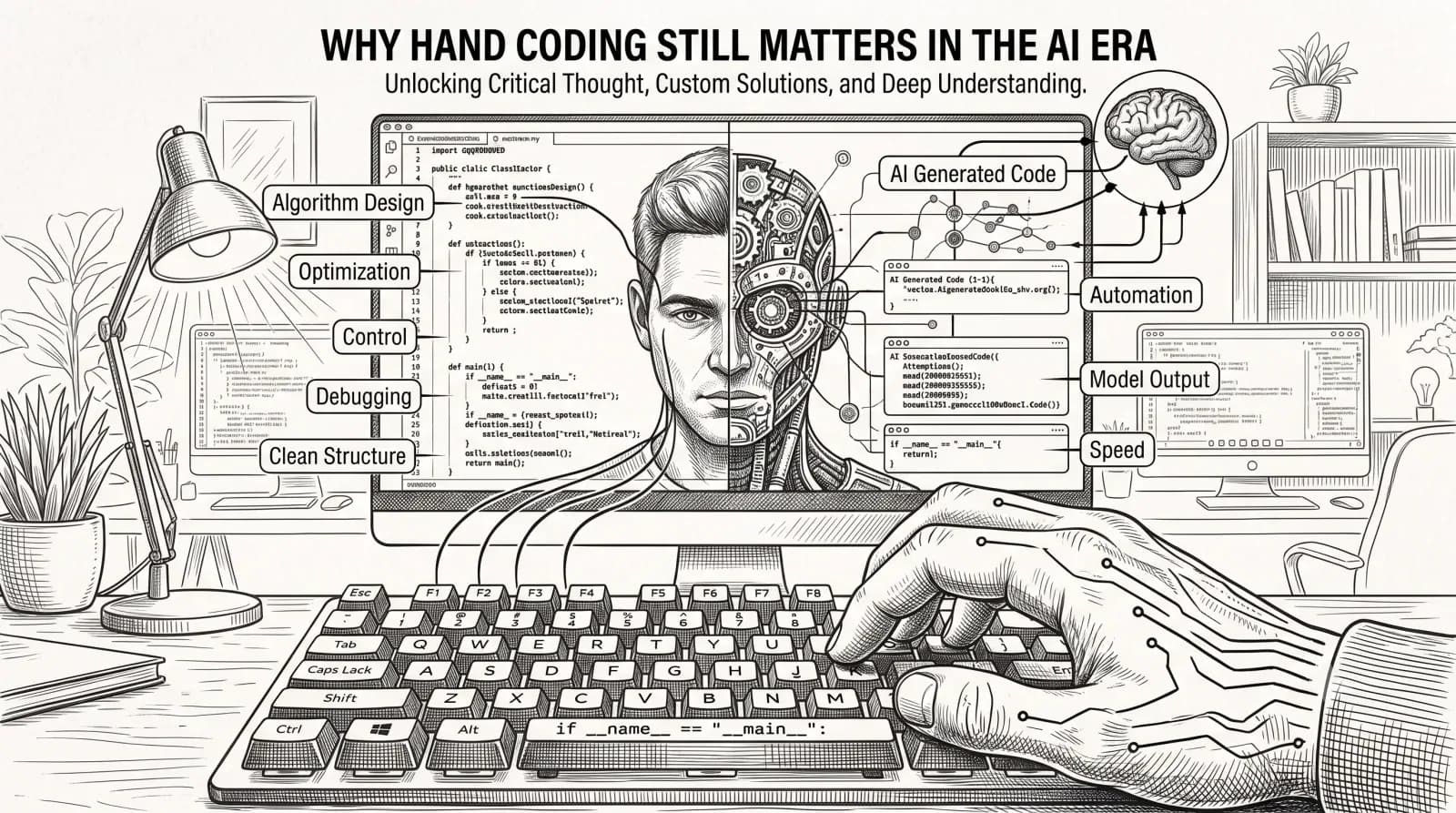
Why Writing Code by Hand Still Matters in the AI Era
AI can write your code.
But if you don't understand what it's writing, you're not a developer you're a copy-paste machine with a fancy tool.
I use AI every day. GitHub Copilot, ChatGPT, Claude they're in my workflow and I'm not pretending otherwise.
But the moment I stopped writing code by hand and started blindly accepting AI suggestions, something broke.
Not in the codebase. In me.
What AI Is Actually Doing
Let's be honest about what these tools are.
They're prediction engines trained on billions of lines of code written by humans who understood the fundamentals.
They autocomplete patterns they've seen before.
They don't debug. They don't reason. They don't know your architecture.
When you ask AI to fix a bug, it guesses based on surface patterns and sometimes it guesses wrong in ways that are very hard to spot if you don't know the basics yourself.
The output looks right. It compiles. It runs.
And then it breaks in production.
The Hidden Cost of Skipping Fundamentals
When I first started leaning hard on AI tools, my output speed increased.
My understanding did not.
Here's what I started to notice:
You can't review what you don't understand
AI generates code fast. But code review requires human judgment.
If you don't understand closures, async behavior, or state management how do you know if the AI's suggestion is actually correct?
You can't. So you merge it and hope.
You can't debug AI-generated code without basics
AI-generated bugs are subtle. They often come from the AI misunderstanding your intent, not from syntax errors.
Debugging those requires reading the code carefully, understanding execution flow, and knowing what should happen.
That's not something you can outsource.
You become dependent on a tool you don't control
Models get updated. APIs change. Tools go down.
If your ability to write code is entirely tied to an autocomplete tool, you've built your career on a dependency you don't own.
What "Basics" Actually Means
I'm not saying you need to memorize every array method or implement a binary search from scratch.
I mean this:
| Know this | Because |
| How the DOM works | So you understand why React does what it does |
| What async/await actually does | So AI-generated async code doesn't silently fail |
| CSS box model and flow | So you can fix layouts AI gets wrong |
| HTTP request/response cycle | So you understand what your fetch calls are doing |
| How state flows in your framework | So you catch bugs AI introduces in prop drilling or context |
These aren't gatekeeping prerequisites.
They're the mental models that let you use AI effectively instead of being used by it.
Hand Coding Teaches You to Think
When you write code by hand, you make decisions.
You think about naming. You think about structure. You think about what happens when the input is empty, or the network fails, or the user does something unexpected.
AI doesn't think about your user.
You do.
That thinking — the act of writing even a small function from scratch trains a kind of problem-solving instinct that you simply cannot develop from reviewing AI output.
The Interview Will Find You Out
Here's the uncomfortable truth for developers who've built projects almost entirely with AI:
Technical interviews still ask you to code.
Not "ask Claude and paste the result."
Not "use Copilot and explain what it wrote."
Actually write a function. Explain your reasoning. Debug it live.
If your fundamentals are weak, this is where it shows.
And the gap between "built projects with AI" and "can explain what the code does" is visible the moment you're on a call with a senior engineer.
What I Do Now
I use AI as a senior dev uses Stack Overflow to move faster on things I already understand.
My actual practice looks like this:
- New concept? I code it manually first, then use AI to review or refactor.
- Stuck on syntax? I try to figure it out, use AI to confirm, not to replace.
- AI writes a block of code? I read every line before I accept it.
- Learning something new? I build a small version without AI first.
The goal isn't to avoid AI.
The goal is to remain the developer in the room.
A Rule Worth Following
If you can't explain what a piece of code does line by line, you don't own it.
And code you don't own will eventually cost you in a debugging session, in an interview, or at the moment when the AI tool gives you a confident wrong answer.
Final Thoughts
AI is the most powerful tool available to developers right now.
But a tool is only as good as the person using it.
The developers who will thrive in this era aren't the ones who use AI the most
they're the ones who understand enough to use it correctly.
Write code by hand.
Break things and fix them.
Read the output, not just the result.
The fundamentals aren't the alternative to AI tools.
They're what makes you good enough to use them.